
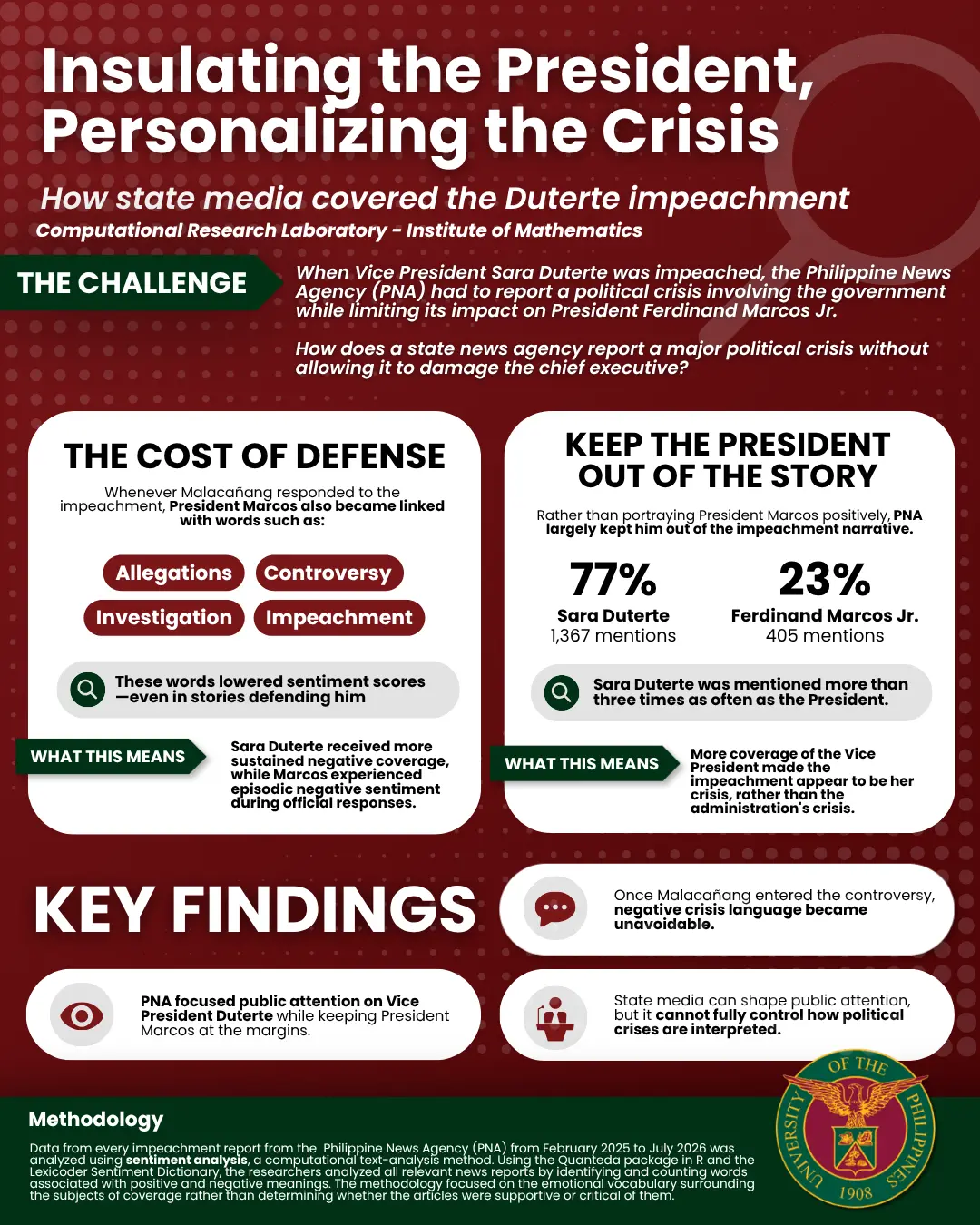
When Vice President Sara Duterte faced impeachment, the Philippine News Agency (PNA)—the government’s official news service—found itself reporting not on an opposition scandal but on a crisis at the heart of government. Although the impeachment formally targeted the Vice President, it inevitably raised broader questions about President Ferdinand Marcos Jr., the stability of his administration, and the collapse of the political alliance that had swept both leaders into office in 2022.
How does a state news agency report a major political crisis without allowing it to damage the chief executive?
To answer this question, we capitalized on a computational method called sentiment analysis. This technique measures the emotional tone of news coverage by counting words associated with positive and negative meanings. Sentiment analysis works by scanning large collections of text and identifying words that carry emotional weight. Words like “success,” “achievement,” and “progress” are classified as positive. Words like “allegations,” “investigation,” “controversy,” and “wrongdoing” are classified as negative. By counting how many positive and negative words appear in stories mentioning each political figure, researchers can calculate a daily “sentiment score” that shows whether coverage leans positive or negative.
Before we proceed, we must note that sentiment analysis does not determine whether an article supports or criticizes the subject of reportage. It only measures the emotional vocabulary surrounding them. A report stating that an official “denied allegations” or “rejected accusations” will still receive a negative sentiment score because words like “allegations” and “accusations” are classified as negative terms—even when they appear in a defensive context.
Using the Quanteda package in R together with the Lexicoder Sentiment Dictionary, we analyzed every PNA report related to the impeachment published between February 2025 and July 2026. For each day, two indicators were calculated: attention (how many times the president and the vice president was mentioned) and sentiment (the balance between positive and negative words in those mentions).
The strategy: Keep the president out of the story
The data suggest that PNA protected President Marcos Jr. not by portraying him positively, but primarily by keeping him out of the story. As the impeachment intensified, Vice President Sara Duterte came to dominate official coverage, personalizing the crisis around one political actor rather than the administration as a whole. Between February 2025 and July 2026, the vice president was mentioned 1,367 times while the president was mentioned only 405 times. In other words, Sara Duterte appeared in PNA news coverage more than three times as often as the president.
Table 1: Total Mentions in PNA Impeachment Coverage (February 2025 – July 2026)
| Political Figure | Total Mentions | Percentage of Total |
| Sara Duterte | 1,367 | 77.20% |
| Ferdinand Marcos Jr. | 405 | 22.80% |
| Total | 1,772 | 100% |
The gap appeared to have widened dramatically as the impeachment developed. In early February 2025, coverage still reflected the political connection between the two leaders. On February 7, 2025, Marcos appeared in 15 stories while Duterte was mentioned only 10 times. By mid-2025, their trajectories began to diverge. On June 10, 2025, Duterte appeared in 23 PNA stories compared to 10 for Marcos. One week later, on June 17, 2025, Duterte was mentioned 15 times while Marcos appeared only once.
The difference became unmistakable in 2026 as impeachment proceedings intensified:
- April 14, 2026: Duterte 26 mentions, Marcos 10 mentions
- April 28, 2026: Duterte 25 mentions, Marcos 2 mentions
- April 29, 2026: Duterte 36 mentions, Marcos 2 mentions
During the intense week of July 6-14, 2026, at the height of the impeachment proceedings, Duterte was mentioned between 27 and 35 times per day, while Marcos only between 3 and 14 times per day
- On July 6: Duterte 35 mentions, Marcos 5 mentions
- On July 7: Duterte 32 mentions, Marcos 14 mentions
- On July 8: Duterte 35 mentions, Marcos 5 mentions
- On July 13: Duterte 27 mentions, Marcos 6 mentions
- On July 14: Duterte 28 mentions, Marcos 9 mentions
Figure 1: Daily Mentions of Sara Duterte and Ferdinand Marcos Jr. in PNA Coverage (February 2025 – July 2026)
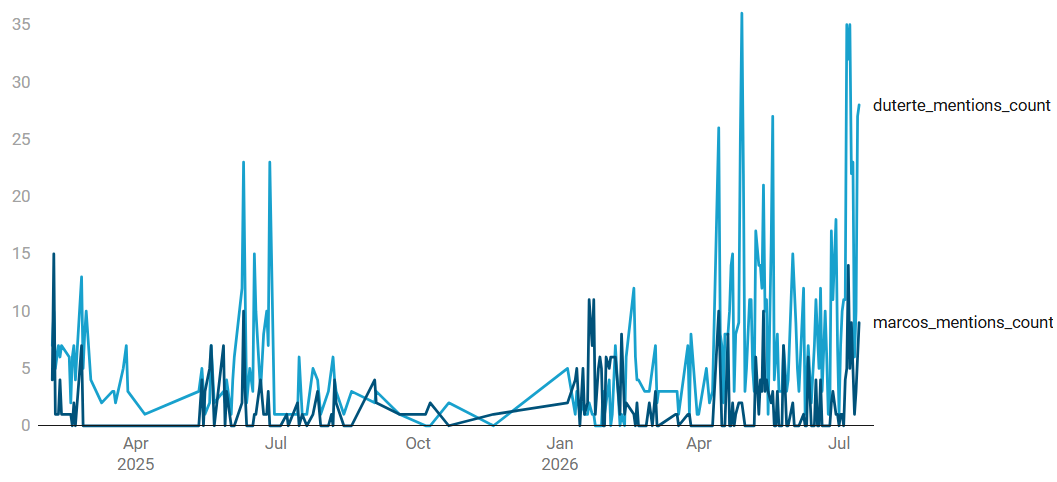
Why does this matter? Naturally, when one person dominates the news coverage of a crisis, readers associate that crisis with them. By featuring the vice president so heavily while keeping Marcos in the background, the PNA effectively framed this as a Duterte’s problem rather than an administration’s problem. Hence, there was not even a need to paint the president in a positive light. The point was to insulate him from the negative story altogether.
Cost of defense
While such strategy is expected of a state media agency, it has its limits. Whenever Malacañang was forced to respond, for example, the President inevitably became part of the story, and with him came the language of allegations, investigations, and political conflict. Whether intended as defense or not, these were also the words readers encountered, making the administration’s efforts to distance the President from the crisis increasingly difficult to sustain.
For instance, when the Palace had to defend the President or explain the administration’s position, they also had to use words like “allegations,” “investigation,” “controversy,” and “impeachment.” These are negative words by nature, regardless if they were uttered in the context of denial.
Since sentiment analysis counts emotional vocabulary regardless of context, stories defending the President still receive negative sentiment scores if they contain crisis-related language. The data show this pattern clearly. On days when Marcos was mentioned because the Palace was responding to the crisis, his sentiment score dropped sharply:
- January 19, 2026: Marcos mentioned 2 times, sentiment score: −7.66
- January 20, 2026: Marcos mentioned 11 times, sentiment score: −4.26
- March 4, 2026: Marcos mentioned 3 times, sentiment score: −8.61
- June 11, 2026: Marcos mentioned 6 times, sentiment score: −8.95
These were not attacks on the President by his own press office. They were moments when his office had to respond—and in doing so, had to use the language of crisis. The negative sentiment scores reflect the vocabulary of defense, not the tone of criticism.
Table 2: Key Dates When Marcos’s Sentiment Declined During Official Responses
| Date | Marcos Mentions | Marcos Net Sentiment | Duterte Net Sentiment | Context |
| 19-Jan-26 | 2 | −7.66 | −13.46 | Palace response to impeachment developments |
| 20-Jan-26 | 11 | −4.26 | −9.19 | Increased presidential visibility during defense |
| 4-Mar-26 | 3 | −8.61 | −11.44 | Simultaneous negative coverage of both leaders |
| 11-Jun-26 | 6 | −8.95 | −2.38 | Both figures experience negative sentiment |
Duterte’s coverage contained more than twice as many negative words as positive words on average. Her net sentiment score of −3.13 was more than four times worse than Marcos’s score of −0.70. On the worst days, Duterte’s coverage was overwhelmingly negative:
- September 19, 2025: −15.39 sentiment score
- January 14, 2026: −13.04 sentiment score
- January 19, 2026: −13.46 sentiment score
- March 4, 2026: −11.44 sentiment score
- July 12, 2026: −10.86 sentiment score
Interestingly, despite being mentioned far less frequently, President Marcos still suffered collateral damage, at least through negative news sentiment (Table 3). Marcos’s net sentiment score of −0.70 is critical. It is not positive. Despite being the president and despite state media protection, his coverage still carried negative emotional weight. This suggests that in this political crisis, even if the president tried to stay out of the story, he could not extricate himself entirely.
So what if there is negative sentiment?
There is an important psychological effect that goes beyond simple word counts. Although this study has not tested reader perceptions directly, communication research suggests that the mood of news coverage can steer selective attention and interpretation, and raise doubts in the minds of audiences. When readers repeatedly encounter negative vocabulary surrounding a political figure, even in defensive contexts, it can legitimately point to uncertainty about the narrative.
For instance, when a president defends himself against allegations, the very act of defense acknowledges that allegations exist. The words needed to deny wrongdoing—”allegations,” “investigation,” “controversy”—are themselves markers of political trouble. Even if reportage is not casting the president in a bad light, the presence of these negative terms can raise questions about credibility. Readers may wonder: why is there an investigation at all? What prompted these allegations? The negative sentiment, while not evidence of hostile reporting, creates a psychological environment where doubt can legitimately take root.
Again, the negative sentiment scores in this data do not suggest the PNA was undermining the president. But they do reveal that the vocabulary of defense carries with it the vocabulary of doubt.
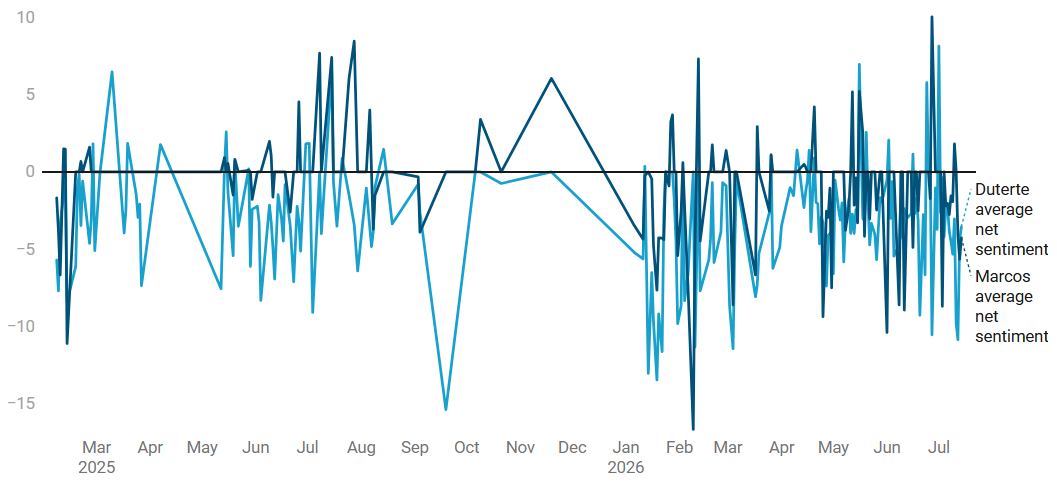
Vice President Duterte’s net sentiment trend is characterized by sustained, cumulative negativity. From the early months of the crisis, her net sentiment consistently remained in the negative, punctuated by severe plunges that directly correlated with spikes in her mention counts. For example, her net sentiment dropped to −15.39 on September 19, 2025, −13.46 on January 19, 2026, and −10.86 on July 12, 2026. Her negative sentiment was a heavy, continuous burden tied to her constant presence in the narrative (Figure 2).
In contrast, President Marcos’s net sentiment trend is episodic and reactive. For large stretches of the seventeen-month period, his net sentiment hovered near zero or was simply absent due to a lack of mentions. However, the data reveals sharp, isolated negative drops during specific defensive moments. For instance, on January 19, 2026, despite only two mentions, his net sentiment plunged to −7.66. Similar reactive drops occurred on March 4 (−8.61 with 3 mentions) and June 11 (−8.95 with 6 mentions).
Marcos’s negative sentiment, while significantly less frequent, was an unavoidable byproduct of his administration’s defensive posture. Even with far fewer mentions, the necessary use of crisis vocabulary immediately drove his net sentiment downward.
Figure 2. Comparing average net sentiment of Marcos and Duterte in PNA coverage (February 2025 – July 2026)
Key takeaways
The impeachment of Vice President Sara Duterte posed an unusual challenge for state media because it threatened to become not only a story about one elected official, but also a story about the administration itself. The evidence suggests that PNA responded by directing public attention toward the Vice President while keeping the President at the margins of the narrative whenever possible. But political crises rarely remain confined to a single actor. Once Malacañang was drawn into the controversy, the language of the crisis inevitably followed.
That distinction matters. The negative sentiment surrounding President Marcos does not necessarily indicate hostile reporting. Rather, it reveals the limits of narrative management. A government can shape where public attention falls, but it cannot fully control the meanings that emerge once it enters the conversation. Defending a political leader against controversy inevitably requires engaging with the controversy itself.
More broadly, the findings remind us that state media do more than report political events—they also help define whose crisis it becomes. Yet the same data also suggest that while attention can be redirected, responsibility cannot always be so neatly contained. In moments of political rupture, even efforts to shield power can leave traces of the very crisis they seek to manage.