
Read the text of any major executive order Ferdinand Marcos Jr. has signed since 2022, and the country appears to be in freefall. Rice cartels are starving the nation. The power grid is failing. Corruption is draining the treasury. Offshore gaming operators are a national security threat. The language is consistently urgent, sometimes even alarming. Is this merely the conventional language of legal drafting, or does it reveal something about how the administration governs?
In a sense, negative language in executive orders is structurally required. Every order must justify intervention by acknowledging a problem in its preamble. We argue, however, that the persistence, intensity, and distribution of negative language act as a measurable signal of how the administration constructs the necessity of its own action. The preamble clauses are not just legal formalities; they are political performances that frame the stakes, define the threats, and establish the scope of executive authority. As such, studying sentiment in executive orders exposes the hidden architecture of state legitimacy, showing how the government justifies its interventions, frames its authority, and what that justification costs in bureaucratic complexity.
Text sentiment and state legitimation
Every executive order is an act of legitimation. The state cannot simply act. It must justify. It must explain why intervention is necessary, why it is authorized, and why it is legitimate.
The WHEREAS clauses are the state’s justification. They describe the problem. They establish the necessity of intervention. They frame the stakes. The ORDERED clauses are the state’s action. They deploy government machinery. They direct agencies. They implement policy.
The relationship between justification and action is the core of governance. When the justification is grave, the action appears necessary. When the justification is routine, the action appears routine. The sentiment of the text reveals how the state navigates this relationship.
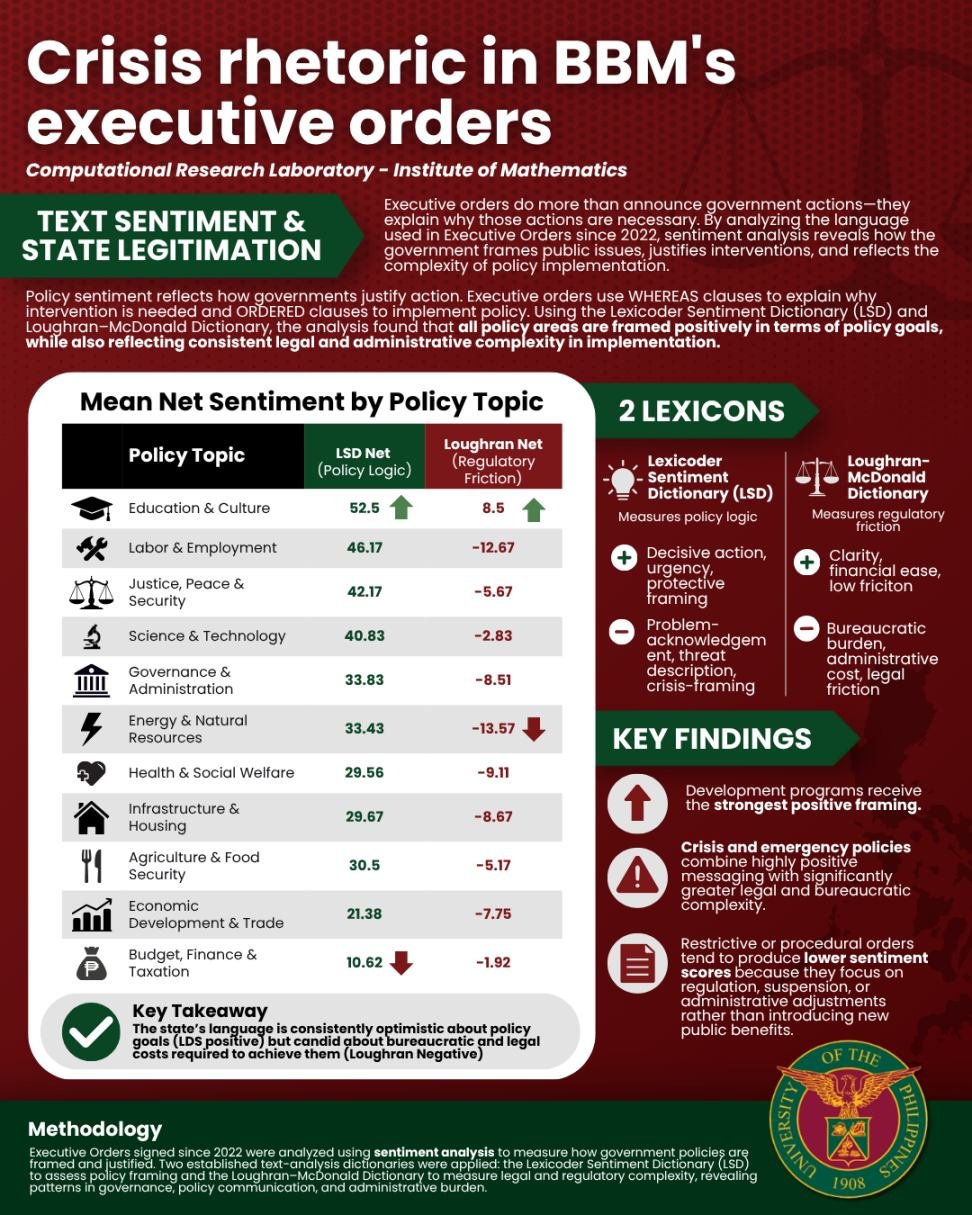
Two lexicons are worth noting. The LSD (Lexicoder Sentiment Dictionary) is designed for political texts. It captures political framing—how the state positions itself, how it justifies action, how it constructs the stakes. LSD positivity indicates decisive action, urgency, and protective framing. LSD negativity indicates problem-acknowledgment, threat-description, and crisis-framing. Meanwhile, the Loughran-McDonald is designed for financial and legal texts. It captures regulatory complexity—legal citations, procedural rules, fiscal constraints, institutional coordination. Loughran negativity indicates bureaucratic burden, administrative cost, and legal friction.
The Lexicoder Sentiment Dictionary (LSD), which measures policy logic, yields a strongly positive net score across every single category. The state frames its actions as beneficial, protective, and developmental (Table 1).
Conversely, the Loughran-McDonald dictionary, which captures regulatory, legal, and financial friction, yields a negative net score across every category. Every mandate carries an administrative cost, and the text must account for it.
Table 1: Mean Net Sentiment by Policy Topic
| Policy Topic | LSD Net (Policy Logic) | Loughran Net (Regulatory Friction) |
| Education & Culture | 52.5 | 8.5 |
| Labor & Employment | 46.17 | -12.67 |
| Justice, Peace & Security | 42.17 | -5.67 |
| Science & Technology | 40.83 | -2.83 |
| Governance & Administration | 33.83 | -8.51 |
| Energy & Natural Resources | 33.43 | -13.57 |
| Health & Social Welfare | 29.56 | -9.11 |
| Infrastructure & Housing | 29.67 | -8.67 |
| Agriculture & Food Security | 30.5 | -5.17 |
| Economic Development & Trade | 21.38 | -7.75 |
| Budget, Finance & Taxation | 10.62 | -1.92 |
Interestingly, the orders with the most extreme negative Loughran net scores are not the orders with the most alarming emotional language. They are the orders where the state takes on massive bureaucratic, legal, or fiscal obligations.
Table 2: The Highest Regulatory Friction (Most Negative Loughran Net)
| Executive Order | Policy Area | Loughran Net | LSD Net | Interpretation |
| EO 107 | Military Compensation | -74 | -22 | Massive fiscal restructuring and multi-year budgetary constraints |
| EO 79 | Makabata Child Protection | -56 | 37 | Complex inter-agency coordination and legal framework for child rescue |
| EO 94 | Infrastructure Commission | -54 | 67 | Subpoena powers, asset freezes, and anti-corruption legal density |
| EO 24 | Disaster Response Task Force | -49 | 5 | Mobilization of 38 agencies and activation of emergency funds |
| EO 110 | National Energy Emergency | -35 | 122 | Geopolitical crisis response requiring whole-of-government resource allocation |
EO 107 updates military base pay and has an LSD net score of -22, making it one of the few orders with a negative policy logic score. This is not because the policy is inherently negative but because the language of the order lacks a grand remedial narrative. The text is dense with appropriations, liabilities, and tranches. It is purely a fiscal and bureaucratic restructuring. The state is not projecting crisis; it is doing complex accounting. Even the Loughran net score of -74 captures this administrative burden.
On the other hand, EO 94 (creating an anti-corruption infrastructure commission) maintains a highly positive LSD net score (+67) because it talks about accountability. However, its Loughran net score plunges to -54. This is because investigating graft requires navigating procurement laws, jurisdictional boundaries, and hold departure orders. These are structures that Loughran construes as negative.
Explaining negative sentiment in Executive Orders
There are only five orders in the entire dataset where the LSD net score drops below zero. These exceptions perfectly illustrate the limits of the state’s positive framing (Table 3).
Table 3: Orders with Negative Policy Logic (LSD Net)
| Executive Order | Policy Area | LSD Net | Loughran Net | Reason for Negative LSD Net | |
| EO 107 | Military Compensation | -22 | -74 | Pure fiscal restructuring; no grand remedial narrative | |
| EO 9 | E-Sabong Suspension | -13 | -22 | Pure prohibition; restricts activity without offering a new benefit | |
| EO 15 | Renaming Complaint Center | -5 | -12 | Minor administrative tweak; lacks substantive policy action | |
| EO 36 | IPP Tax Condonation | -2 | -14 | Narrow fiscal adjustment to prevent utility defaults | |
| EO 42 | Lifting Rice Price Ceiling | -1 | -12 | Policy reversal; repeals a measure without launching a new one | |
When the state merely prohibits an activity (EO 9), tweaks an office name (EO 15), or reverses a policy (EO 42), it cannot generate the positive, remedial language found in welfare or development orders. One cannot use words like build, provide, improve, protect, or support when the entire point of the document is to say “we are stopping this” or “we are just changing a label.” Because the document lacks those positive action words, the negative or procedural words (like suspend, repeal, violation, modify) naturally outweigh them, dragging the net score into the negative.
For example, EO 9 banning e-sabong is a policy that prohibits. The text is filled with words like suspended, illegal, violation, crackdown, and prohibited. It does not hand out a new benefit or build a new program to balance those words out. Therefore, the negative words win, and the net score drops. Meanwhile, EO 15 simply renames the “Presidential Complaint Center” to the “Presidential Action Center.” The text is dry, procedural boilerplate (“WHEREAS, EO No. X did Y… NOW THEREFORE, we rename it”). It lacks any grand, positive, forward-looking vision. Because there is no new “positive” action being described, the net score remains low or negative.
EO 42, for its part, lifts the rice price ceiling. Its purpose is to repeal or remove a previous rule. The language is entirely about lifting, repealing, and modifying. It does not launch a new positive policy; it just takes an old one away.
If we examine the executive orders further, they seem to sort naturally into three distinct operational clusters (Table 4). They are either prohibitory, procedural, or modifying policies.
Table 4: Policy Logic vs. Administrative Friction
| Executive Order | Policy Area | LSD Net (Policy Logic) | Loughran Net (Regulatory Friction) |
| EO 44 | Food Stamp Program | 48 | 1 |
| EO 52 | Pag-Abot Program | 112 | -2 |
| EO 103 | Devolution to LGUs | 163 | -14 |
| EO 39 | Rice Price Ceiling | 2 | -25 |
| EO 74 | POGO Ban | 63 | -35 |
| EO 110 | National Energy Emergency | 122 | -35 |
| EO 94 | Infrastructure Commission | 67 | -54 |
| EO 107 | Military Compensation | -22 | -74 |
| EO 9 | E-Sabong Ban | -13 | -22 |
Orders like EO 44 (Food Stamp Program), EO 52 (Pag-Abot Program), and EO 103 (devolution to LGUs) share a distinct profile. It has highly positive policy logic scores (+48 to +163) paired with neutral or only slightly negative friction scores (+1 to -14). This makes intuitive sense. When the government is simply distributing benefits, expanding services, or streamlining administrative processes, the language is overwhelmingly positive. These actions do not require navigating complex legal or fiscal hurdles, the administrative friction remains minimal.
Orders like EO 110 (National Energy Emergency), EO 74 (POGO ban), and EO 94 (Infrastructure Commission) present a stark contrast. They maintain high positive policy logic scores (+63 to +122), but their Loughran friction scores plunge into negative territory (-35 to -54). This reveals a crucial dynamic of crisis governance. The state uses highly positive, action-oriented language to sell major interventions and project strength. However, the text is simultaneously weighed down by the complex legal, fiscal, and bureaucratic requirements needed to actually execute them. The data exposes the heavy administrative machinery required to enforce the state’s will.
Orders like EO 107 (Military Compensation) and EO 9 (e-sabong ban) sit at the opposite end of the spectrum. They feature negative policy logic scores (-13 to -22) combined with highly negative friction scores (-22 to -74). These documents lack a grand, positive remedial narrative. Their sole purpose is to suspend an activity, adjust a rigid pay scale, or manage complex fiscal restructuring. Without positive, forward-looking language to balance it out, the dense administrative, prohibitive, and fiscal terminology drags both the policy logic and the friction scores into the negative.
Conclusion: The cost of executive power
What do these patterns suggest? First, the Philippine executive state consistently relies on positive, remedial framing. Rather than emphasizing prohibition or punishment, executive orders are generally written in language that projects action, coordination, and institutional authority across a wide range of policy areas.
Second, governance through enforcement and crisis response appears to carry a measurable linguistic cost. Executive orders dealing with security, anti-corruption, fiscal regulation, and emergency interventions register substantially lower Loughran net scores than those addressing routine administration or development. This does not necessarily mean that these policies are framed more negatively. Instead, they require a denser vocabulary of legal obligations, restrictions, compliance mechanisms, risks, and contingencies that naturally depress net sentiment.
In other words, the analysis suggests that the more the executive intervenes in complex or high-stakes policy domains, the more its language shifts from aspirational objectives to the practical realities of implementation. Executive orders in these areas do not merely announce government action. They also reveal the institutional complexity, legal constraints, and administrative burdens involved in exercising state authority. The language therefore reflects not only what government intends to do, but also the organizational effort required to make those intentions operational.